
Getting through a job interview is an important achievement, but the recruitment process does not necessarily end when you leave the interview room or close your video call. What you do after a job interview can influence how professionally you are remembered, help maintain communication with the employer and give you an opportunity to reinforce your interest in the position.
However, following up does not mean repeatedly messaging the recruiter, calling the hiring manager every day or asking whether you have been selected before the employer’s stated decision date. Effective follow-up is about professional communication, appropriate timing and patience.
A strong post-interview strategy can help you stay visible without becoming intrusive. It can also help you learn from the experience, maintain professional relationships and prepare for whatever comes next.
This comprehensive guide explains what candidates should do immediately after an interview, when to send a thank-you message, how to follow up professionally, what to do when an employer does not respond, and how to handle rejection or a job offer.
Why Is Follow-Up After a Job Interview Important?
A job interview allows an employer to evaluate your qualifications, experience, communication skills and suitability for the position.
The period afterward gives you an opportunity to demonstrate another important quality:
professionalism.
A thoughtful follow-up can reinforce your interest in the role and remind the interviewer of the value you discussed during the interview.
It can also help you correct a small omission.
For example, suppose the interviewer asks whether you have experience using a particular software application and you remember afterward that you have relevant experience that you did not mention.
A concise follow-up message can provide that additional information without overwhelming the recruiter.
What Should You Do Immediately After a Job Interview?
Don’t immediately start sending messages.
Take a few minutes to reflect on the conversation.
Write down:
- Questions you were asked.
- Questions you answered particularly well.
- Questions you struggled with.
- Skills the interviewer emphasized.
- Problems the company is trying to solve.
- Information you learned about the position.
- Any additional information you promised to provide.
- The expected timeline for the hiring decision.
- Names and roles of the people you interviewed with.
This information can become extremely useful when preparing your follow-up message.
It will also help you improve your performance in future interviews.
1. Write Down the Interviewer’s Key Points
Interviewers often reveal important information during conversations that may not appear in the job description.
For example, the hiring manager might explain:
“We’re looking for someone who can help us improve our customer response time.”
That information should influence your follow-up.
Instead of sending a generic:
“Thank you for the interview. I look forward to hearing from you.”
you could write:
“I particularly appreciated learning about the team’s goal of improving customer response times. My previous experience managing customer enquiries and tracking follow-ups would allow me to contribute meaningfully in that area.”
That is more memorable because it connects your experience to an actual business need.
2. Send a Thank-You Message
One of the most straightforward post-interview actions is sending a brief thank-you message.
A thank-you email should generally:
- Thank the interviewer for their time.
- Mention something specific from the conversation.
- Reinforce your interest in the position.
- Briefly remind them of your relevant value.
- Close professionally.
It does not need to be long.
A concise and personalized message is usually better than a lengthy essay.
Example of a Professional Thank-You Email
Subject: Thank You for the Interview – [Job Title]
Dear [Interviewer’s Name],
Thank you for taking the time to speak with me today about the [Job Title] position at [Company Name].
I particularly enjoyed learning more about [specific project, responsibility or challenge discussed during the interview]. Our conversation further strengthened my interest in the opportunity.
I believe my experience in [relevant skill/area] would allow me to contribute effectively to the team, particularly in [specific area].
Thank you again for your time and consideration. I look forward to hearing from you.
Kind regards,
[Your Name]
The important element is personalization.
Don’t send exactly the same message to every interviewer.
When Should You Send a Follow-Up Email?
Timing matters.
A thank-you message should generally be sent relatively soon after the interview while the conversation is still fresh.
For most interviews, sending it the same day or within 24 hours is a reasonable approach.
If you interviewed with multiple people, you can send separate messages when you have their contact information.
Alternatively, if communication is handled through a recruiter, you can send your appreciation through the appropriate channel.
The goal isn’t to appear desperate.
The goal is to demonstrate professional courtesy while the conversation is still recent.
What If You Don’t Have the Interviewer’s Email Address?
Don’t panic.
You have several options.
Option 1: Contact the Recruiter
If the recruiter arranged the interview, send your message to the recruiter and ask them to pass along your appreciation.
Option 2: Use the Company’s Communication Channel
If the interview was arranged through a recruitment platform, use the platform’s approved communication system if appropriate.
Option 3: LinkedIn
If the interviewer has a professional LinkedIn profile and the circumstances make it appropriate, a brief connection request can be considered.
However, don’t bombard the person across multiple platforms.
Choose one professional communication channel.
What Should You Include in a Follow-Up Message?
A good follow-up message should answer three questions:
1. Did you appreciate the opportunity?
Say thank you.
2. Are you still interested?
Make your interest clear.
3. Why are you a good fit?
Briefly reinforce one relevant qualification or experience.
For example:
“Our discussion about expanding the company’s digital marketing activities was particularly interesting. My experience in SEO, content strategy and website management would allow me to contribute to that objective.”
This is much stronger than simply saying:
“I am still interested in the job.”
Don’t Repeat Your Entire CV
Your follow-up email is not another application.
The interviewer already has your CV.
Instead, focus on one or two points that reinforce your suitability.
For example:
Weak:
“I have a degree in Business Administration, three years of experience, Microsoft Office skills, communication skills, teamwork skills, leadership skills and…”
Better:
“Our discussion reinforced how closely my three years of administrative experience align with the coordination and documentation responsibilities of the position.”
Keep it focused.
What If You Forgot to Mention Something Important?
This happens.
Candidates sometimes leave an interview and suddenly remember an important achievement they should have mentioned.
Don’t send a five-paragraph explanation.
Instead, briefly add the information to your follow-up.
For example:
“One additional point I wanted to mention following our discussion is that, in my previous role, I also supported the implementation of a digital records system. This experience may be particularly relevant to the documentation responsibilities we discussed.”
That is enough.
What If You Made a Mistake During the Interview?
Don’t automatically assume that one imperfect answer has ruined your chances.
Interviews are conversations, and candidates can make mistakes.
If the mistake was minor, don’t draw unnecessary attention to it.
If you gave an objectively incorrect or incomplete answer to an important question, you can clarify it professionally.
For example:
“After reflecting on our discussion, I realized that I could have provided a clearer example when you asked about project coordination. In my previous role, I coordinated…”
Then provide the relevant example.
Don’t write:
“I’m sorry. I performed terribly and I hope you can forgive me.”
Maintain confidence and professionalism.
What If the Interviewer Gives You a Decision Date?
Pay close attention to this.
Suppose the interviewer says:
“We expect to make a decision by Friday.”
Don’t send:
“Any update?”
on Thursday morning.
Wait until the stated period has passed.
If Friday ends without an update, a polite follow-up on the following business day can be appropriate.
This demonstrates patience while still showing interest.
How Long Should You Wait Before Following Up?
There is no universal waiting period because recruitment timelines differ considerably.
The most important factor is the timeline given by the employer.
If they say:
“We’ll get back to you tomorrow.”
Give them that time.
If they say:
“We’ll get back to you next week.”
Wait until the stated period has passed.
If they give no timeline:
A polite follow-up after several business days can be reasonable.
The key principle is:
Follow up based on the employer’s stated timeline whenever possible.
What to Do If the Employer Doesn’t Respond
This is one of the most frustrating parts of job searching.
You may have attended the interview, sent a thank-you message and then heard nothing.
Don’t immediately assume you were rejected.
Recruitment can be delayed by:
- Internal approvals
- Additional interviews
- Budget changes
- Management availability
- Candidate comparisons
- Hiring freezes
- Organizational restructuring
- Changes to the position
- Unexpected business priorities
A delayed response does not always mean a negative decision.
Send a Polite Follow-Up
If the employer’s stated decision date has passed, send a short message.
Example:
Subject: Follow-Up – [Job Title] Interview
Dear [Name],
I hope you’re doing well.
I am writing to follow up regarding my interview for the [Job Title] position on [date].
I remain very interested in the opportunity and enjoyed learning more about [Company Name] and the team’s work.
Please let me know if there are any updates regarding the recruitment process or if you require any additional information from me.
Thank you for your time and consideration.
Kind regards,
[Your Name]
Notice the tone.
It is interested, professional and patient.
Don’t Send Daily Follow-Up Messages
One of the biggest mistakes candidates make is excessive communication.
Avoid sending:
“Hello, any update?”
every day.
Don’t repeatedly call the recruiter.
Don’t send messages through WhatsApp, LinkedIn, email and Instagram simultaneously.
Multiple messages can make you appear impatient rather than enthusiastic.
One well-written follow-up is much more effective.
How Many Times Should You Follow Up?
There is no magic number.
A practical approach is:
First follow-up: After the employer’s stated timeline has passed.
Second follow-up: If there has been no response after a reasonable additional period.
After that, consider moving on while remaining open to hearing from the employer.
Your job search should continue even when you are waiting for one company.
Never Stop Applying Because You Had a Good Interview
This is one of the most important lessons for job seekers.
An interview is not a job offer.
Even if the interviewer says:
“You seem like a great fit.”
you should continue applying until you receive a formal offer and understand the terms.
Hiring decisions can change for reasons unrelated to your performance.
The company may:
- Select another candidate.
- Put the position on hold.
- Cancel the vacancy.
- Change the budget.
- Restructure the department.
- Delay recruitment.
Continue your job search.
Keep a Job Application Tracker
A job tracker can help you manage multiple applications professionally.
Record:
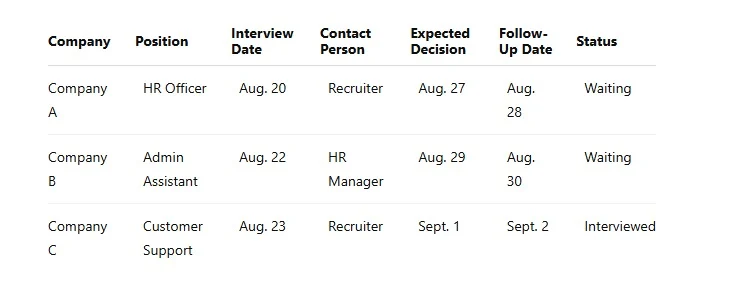
This prevents you from forgetting when you should follow up.
It also makes your job search more organized.
Use the Waiting Period Productively
Don’t spend the entire waiting period checking your email every five minutes.
Use the time to improve your career prospects.
You can:
- Apply for additional positions.
- Improve your CV.
- Update LinkedIn.
- Build your portfolio.
- Learn a new skill.
- Research the company.
- Practise interview questions.
- Prepare for another interview.
- Expand your professional network.
The job search should continue until you have secured employment.
Review Your Interview Performance
Immediately after the interview, evaluate yourself.
Ask:
What did I do well?
Maybe you explained your previous experience effectively.
What questions were difficult?
Perhaps you struggled with:
“Tell me about a time you handled conflict.”
Did I provide specific examples?
If not, prepare better examples for the next interview.
Did I research the company enough?
If not, improve your research process.
Did I ask good questions?
If not, prepare several thoughtful questions.
This turns every interview into a learning experience.
Prepare Better Answers for Your Next Interview
Suppose the interviewer asked:
“Tell me about a time you made a mistake at work.”
And you struggled.
Don’t simply forget about it.
Prepare a structured answer.
The STAR method can help:
- Situation
- Task
- Action
- Result
For example:
“In my previous role, I noticed that an important report contained inconsistent information. I was responsible for correcting the issue before submission. I reviewed the source documents, identified the discrepancy and introduced a verification step before future reports were finalized. As a result, our team reduced similar errors in subsequent reports.”
Now you’re better prepared for the next interview.
What If You Receive a Second Interview?
Congratulations.
A second interview means the employer is continuing the evaluation process.
Don’t assume the first interview means you already know everything.
Prepare again.
Review:
- The original job description.
- Your first interview.
- Questions you were asked.
- Questions you struggled with.
- Information the employer shared.
- The company’s recent activities.
- The responsibilities of the role.
You may also meet a different person during the second stage.
Your answers should remain consistent with what you previously told the organization.
What If the Employer Asks for References?
Respond promptly.
Provide references who can credibly discuss your:
- Work performance
- Professional conduct
- Skills
- Reliability
- Responsibilities
Before giving someone as a reference, ask for their permission.
Make sure you have their correct contact information.
Also tell them about the position you’re applying for so they understand what aspects of your experience may be relevant.
What If You Receive a Job Offer?
Don’t immediately accept just because you’re excited.
Read the offer carefully.
Check:
- Job title
- Salary
- Benefits
- Working hours
- Location
- Remote/hybrid arrangement
- Start date
- Probation period
- Reporting structure
- Contract duration
- Leave entitlement
- Notice requirements
- Other employment conditions
If anything is unclear, ask questions before accepting.
A job offer is a major professional decision.
How to Respond When You Need Time to Consider an Offer
You can say:
“Thank you very much for the offer. I appreciate the opportunity and am excited about the possibility of joining the team. I would like some time to review the terms carefully. Could you please let me know the deadline for my response?”
This is professional and reasonable.
How to Negotiate After Receiving an Offer
If the employer is open to negotiation, approach the conversation professionally.
Don’t simply say:
“I want more money.”
Explain the basis for your request.
For example:
“Thank you for the offer. I’m very interested in the position. Based on my experience in [relevant area] and the responsibilities associated with the role, I was hoping we could discuss whether there is flexibility in the compensation package.”
Remain respectful.
Remember that compensation is only one part of the overall package.
What If You Are Rejected?
Rejection is disappointing, but it doesn’t have to end the professional relationship.
If the employer informs you that another candidate was selected, respond professionally.
For example:
Dear [Name],
Thank you for letting me know and for giving me the opportunity to interview for the [Job Title] position.
Although I am disappointed that I was not selected, I appreciate the time you and the team invested in the process.
If possible, I would appreciate any brief feedback that could help me improve my performance in future opportunities.
I wish you and the team continued success.
Kind regards,
[Your Name]
This leaves a positive impression.
Should You Ask for Feedback After Rejection?
Yes, you can ask.
However, understand that employers may not always provide detailed feedback.
A respectful request is better than demanding an explanation.
Instead of:
“Why didn’t you hire me?”
say:
“If you are able to share any feedback about my interview or application, I would greatly appreciate it as I continue developing professionally.”
Even if the employer doesn’t respond, you’ve handled the situation professionally.
Rejection Can Sometimes Lead to Another Opportunity
Companies occasionally have multiple vacancies or may retain strong candidates for future positions.
A professional response to rejection can therefore help preserve the relationship.
You might be remembered when another suitable position becomes available.
This is one reason why professionalism should continue even after you are unsuccessful.
What If You Are Put on a Waiting List?
If the employer says:
“We are keeping your application under consideration.”
don’t interpret that as either an offer or a rejection.
Respond positively.
For example:
“Thank you for the update. I appreciate your consideration and remain interested in the opportunity. Please feel free to contact me if you require any additional information.”
Then continue your job search.
What If You Are Told You Were the Preferred Candidate?
Remain positive but cautious until you receive a formal offer.
Statements such as:
“You’re our preferred candidate.”
are encouraging.
But they are not necessarily equivalent to a formal employment offer.
Continue communicating professionally and wait for the official documentation.
How to Follow Up After a Virtual Interview
The same principles apply to Zoom, Google Meet and Microsoft Teams interviews.
You can mention something specific from the virtual discussion.
For example:
“Thank you for taking the time to speak with me via Google Meet today. I particularly appreciated learning about your plans to expand the customer support team.”
The communication channel doesn’t change the fundamental principle:
Be concise, relevant and professional.
Following Up After a Panel Interview
Panel interviews require slightly more care.
If you have the contact details of the panel members, you can send personalized thank-you messages.
Don’t send the exact same generic message to everyone.
Instead, refer to something specific each person discussed.
For example:
“I appreciated your explanation of the team’s approach to employee development.”
and:
“I enjoyed learning more about the operational challenges your department is currently addressing.”
This demonstrates that you were engaged throughout the discussion.
Following Up With a Recruiter vs. Hiring Manager
The appropriate person depends on who manages communication.
Recruiter
Contact the recruiter when they are your primary point of contact.
Hiring Manager
If the hiring manager invited you to communicate directly, a direct follow-up can be appropriate.
HR Department
If HR is managing the recruitment process, follow their established communication channel.
The safest rule is:
Use the communication channel the employer has already established.
What Not to Say in a Follow-Up Email
Avoid statements like:
“I really need this job.”
“Please give me the job.”
“I have been waiting for too long.”
“Why haven’t you replied?”
“I know I am the best candidate.”
“I turned down another job because of your company.”
“Please respond immediately.”
These statements can create unnecessary pressure.
Instead, remain confident and professional.
Poor Follow-Up vs. Professional Follow-Up
Poor:
“Hello sir, any update concerning my interview?”
Better:
“Dear Mr. Adeyemi, I hope you’re doing well. I am writing to follow up regarding my interview for the Administrative Officer position on August 20. I remain very interested in the opportunity and would appreciate any update you may be able to share regarding the next stage of the recruitment process. Thank you for your time and consideration.”
The second version communicates the same basic message but demonstrates professionalism.
Don’t Overthink Every Sign From the Interview
Candidates often leave interviews trying to interpret every sentence.
For example:
“The interviewer smiled, so I must have got the job.”
or:
“They didn’t smile, so I must have failed.”
Avoid this.
Interviewers can behave differently for many reasons.
A positive conversation is encouraging, but the final hiring decision may depend on factors you cannot see.
Focus on what you can control:
Your preparation, communication, follow-up and continued job search.
A Simple Post-Interview Timeline
Here is a practical framework you can use.
Immediately After the Interview
Write down important details.
Same Day or Within 24 Hours
Send a concise thank-you message.
During the Stated Waiting Period
Wait patiently.
Do not repeatedly contact the employer.
After the Employer’s Deadline Passes
Send a polite follow-up.
If There Is Still No Response
Wait an appropriate amount of time and consider one additional professional follow-up.
After That
Continue applying for other opportunities.
If You Receive an Offer
Review the terms carefully before accepting.
If You Are Rejected
Thank the employer and, where appropriate, request constructive feedback.
Follow-Up Email Template
Subject: Follow-Up on [Job Title] Interview
Dear [Interviewer’s Name],
I hope you’re doing well.
Thank you again for taking the time to interview me for the [Job Title] position on [Date].
I enjoyed learning more about [Company Name], particularly [specific topic discussed during the interview].
Our discussion reinforced my interest in the position, and I believe my experience in [relevant area] would enable me to contribute effectively to the team.
I wanted to kindly follow up to ask whether there have been any updates regarding the recruitment process.
Please let me know if you require any additional information from me.
Thank you again for your time and consideration.
Kind regards,
[Full Name]
[Phone Number]
[Email Address]
Final Post-Interview Checklist
Before and after sending your follow-up, check the following:
-
Did I thank the interviewer?
-
Did I personalize the message?
-
Did I mention something relevant from the interview?
-
Did I reinforce my interest in the position?
-
Did I briefly remind them of my relevant value?
-
Did I follow the employer’s stated timeline?
-
Did I avoid sending multiple unnecessary messages?
-
Did I check my grammar and spelling?
-
Did I use a professional email address?
-
Did I continue applying for other jobs?
-
Did I record the interview and follow-up dates?
-
Did I prepare for possible next-stage interviews?
Conclusion
Knowing what to do after a job interview is an important part of an effective job-search strategy. The interview itself may determine whether you remain under consideration, but your actions afterward can demonstrate professionalism, organization and genuine interest in the opportunity.
The most effective approach is straightforward: thank the interviewer, reflect on the conversation, provide any genuinely relevant additional information, follow up according to the employer’s timeline, and remain patient.
Most importantly, don’t put your entire job search on hold while waiting for one company.
Continue applying, improving your skills, attending interviews and expanding your professional network. A successful job search is rarely about one application; it is about maintaining a consistent and professional process until the right opportunity comes along.
Remember that following up is about staying professionally connected, not pressuring the employer. A concise, personalized message can leave a positive impression, while repeated calls and messages can have the opposite effect.
Whether you receive an offer, another interview, a rejection or no immediate response, handle every outcome professionally. Today’s unsuccessful application could still become tomorrow’s professional connection, and the interview experience itself can help you perform better in the next opportunity.
The goal after every interview should therefore be simple:
Follow up professionally, learn from the experience, remain patient and keep moving forward.