
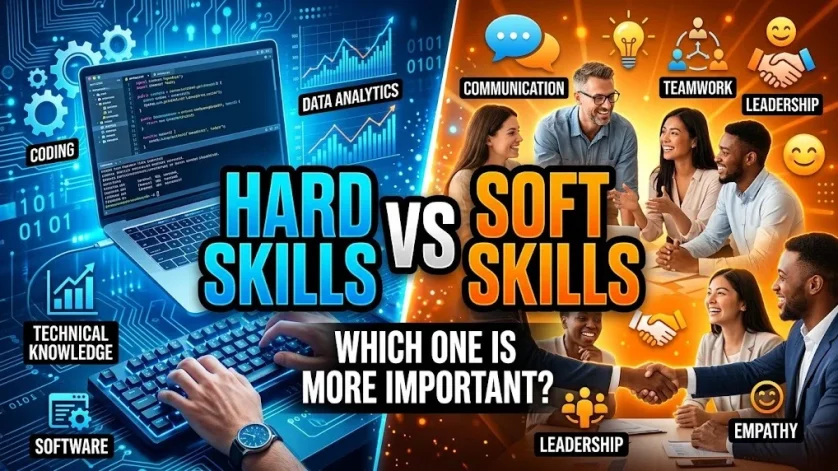
When employers evaluate candidates, one question often comes to mind: Do technical abilities matter more than personality and communication skills?
The debate between hard skills vs soft skills has become increasingly important as workplaces evolve. Employers need people who can perform specific tasks, but they also need employees who can communicate, collaborate, solve problems, adapt to change and work effectively with others.
A software developer may have excellent programming skills but struggle to communicate with clients. An administrative officer may communicate exceptionally well but lack the technical ability to manage spreadsheets and databases. A salesperson may understand sales techniques but struggle to build relationships with customers.
In each situation, one type of skill alone may not be enough.
The reality is that hard skills and soft skills serve different purposes, and successful employees often need a combination of both.
For job seekers, understanding the difference can help you decide what to learn, improve your CV, perform better in interviews and become more competitive in the employment market.
What Are Hard Skills?
Hard skills are specific, teachable and measurable abilities that enable a person to perform particular tasks or functions.
They are usually acquired through:
- Education.
- Training.
- Certification.
- Apprenticeships.
- Internships.
- Professional experience.
- Practical projects.
- Self-directed learning.
Hard skills are often relatively easy for employers to identify and assess.
For example, an employer recruiting an accountant may require knowledge of accounting principles and financial reporting.
An employer hiring a graphic designer may require proficiency in design software.
A software company may require knowledge of programming languages.
Examples of Hard Skills
Hard skills vary significantly depending on the profession.
Technology
- Programming.
- Web development.
- Database management.
- Cybersecurity.
- Cloud computing.
- Data analysis.
- Software testing.
- Artificial intelligence.
- Network administration.
Finance
- Bookkeeping.
- Financial analysis.
- Budget preparation.
- Tax preparation.
- Financial reporting.
- Accounting software.
Marketing
- Search engine optimization.
- Digital advertising.
- Google Analytics.
- Content marketing.
- Email marketing.
- Market research.
- Marketing automation.
Administration
- Microsoft Excel.
- Microsoft Word.
- Data entry.
- Records management.
- Document management.
- Spreadsheet analysis.
- Database management.
Engineering
- Computer-aided design.
- Electrical testing.
- Circuit analysis.
- Technical drawing.
- Equipment maintenance.
- Project management.
- Engineering software.
Creative Professions
- Graphic design.
- Video editing.
- Photography.
- UI/UX design.
- Animation.
- Audio production.
These skills can often be demonstrated through tests, certifications, portfolios or practical assessments.
What Are Soft Skills?
Soft skills are interpersonal, behavioral and personal capabilities that influence how effectively someone works with other people and handles workplace situations.
They are sometimes called:
- Interpersonal skills.
- Transferable skills.
- Employability skills.
- People skills.
Unlike many technical skills, soft skills are not necessarily tied to one particular profession.
For example, effective communication is useful for:
- Engineers.
- Teachers.
- Accountants.
- Nurses.
- Marketers.
- Administrators.
- Software developers.
- Recruiters.
- Managers.
Examples of Soft Skills
Important soft skills include:
- Communication.
- Teamwork.
- Leadership.
- Problem-solving.
- Critical thinking.
- Time management.
- Adaptability.
- Emotional intelligence.
- Collaboration.
- Creativity.
- Decision-making.
- Conflict resolution.
- Accountability.
- Professionalism.
- Attention to detail.
- Negotiation.
- Customer service.
These skills influence how you use your technical abilities.
Hard Skills vs Soft Skills: The Major Difference
The simplest way to understand the difference is:
Hard skills determine what you can do. Soft skills influence how effectively you do it.
Consider a customer service representative.
Hard skills
The employee may need to know:
- CRM software.
- Customer service procedures.
- Product information.
- Data entry.
- Ticketing systems.
Soft skills
The employee also needs:
- Communication.
- Patience.
- Empathy.
- Problem-solving.
- Active listening.
Having the technical ability to operate the CRM system doesn’t necessarily mean the employee can successfully handle an angry customer.
Both skill categories therefore contribute to performance.
Which Matters More to Employers?
There is no universal answer.
It depends on the job.
For highly technical positions, hard skills may initially carry greater weight.
For roles involving significant interpersonal interaction, soft skills may become particularly important.
However, in many modern workplaces, employers increasingly need both.
A candidate with strong technical skills but poor communication may struggle.
A candidate with excellent interpersonal skills but insufficient technical ability may also struggle.
The strongest candidate is often the person who combines the technical requirements of the job with the interpersonal abilities needed to perform effectively.
Why Hard Skills Matter
Hard skills provide the technical foundation for performing a job.
Imagine an organization is hiring a junior accountant.
The candidate may need to understand:
- Accounting principles.
- Financial statements.
- Excel.
- Bookkeeping.
- Reconciliation.
Without these abilities, the employee may require substantial training before performing basic responsibilities.
That’s why job descriptions frequently contain specific technical requirements.
Hard Skills Can Help You Pass the Initial Screening
Recruitment often begins with a review of applications.
Employers may look for specific qualifications and skills.
For example:
Job Requirement:
“Proficiency in Microsoft Excel, including PivotTables and VLOOKUP/XLOOKUP.”
A candidate who clearly demonstrates those skills has an advantage over someone whose CV only says:
“Computer literate.”
Specific skills make it easier for recruiters to determine whether you meet the technical requirements.
Certifications Can Demonstrate Hard Skills
Certifications can provide evidence that you have completed structured training.
Examples include certifications in:
- Project management.
- Accounting.
- Digital marketing.
- Cybersecurity.
- Data analysis.
- Cloud technologies.
- Human resources.
- Occupational safety.
However, certification should not be confused with competence.
A certificate can demonstrate that you completed training.
A practical project can demonstrate that you can apply the knowledge.
Ideally, develop both.
Why Soft Skills Matter
Technical competence doesn’t happen in isolation.
Employees have to communicate with:
- Managers.
- Colleagues.
- Customers.
- Suppliers.
- Clients.
- Partners.
This makes interpersonal skills important across many occupations.
Consider an employee who is technically excellent but constantly:
- Misses deadlines.
- Refuses to collaborate.
- Communicates poorly.
- Responds badly to feedback.
- Creates unnecessary conflict.
Their technical ability may not compensate for the problems their behavior creates.
Communication Is One of the Most Valuable Soft Skills
Communication affects almost every workplace activity.
Employees communicate through:
- Emails.
- Meetings.
- Reports.
- Presentations.
- Phone calls.
- Video conferences.
- Messaging platforms.
- Face-to-face conversations.
Good communication means more than speaking clearly.
It includes:
- Listening.
- Asking questions.
- Explaining information.
- Writing professionally.
- Adjusting communication to different audiences.
- Giving and receiving feedback.
Practical Example: Two Candidates
Suppose a company is hiring a Digital Marketing Assistant.
Candidate A
Has excellent technical skills:
- SEO.
- Google Analytics.
- Keyword research.
- Content management.
- Social media advertising.
However, during the interview, the candidate struggles to explain ideas and cannot clearly describe previous projects.
Candidate B
Has:
- Good SEO knowledge.
- Basic analytics skills.
- Strong communication.
- Excellent organization.
- Strong problem-solving ability.
- A willingness to learn.
Candidate A may have stronger technical skills today.
But Candidate B may demonstrate greater potential to collaborate, communicate with clients and develop professionally.
The employer’s final decision may depend on the organization’s needs.
This illustrates why the question isn’t always “hard or soft?”
It is often:
“What combination of skills does this particular role require?”
The Importance of Problem-Solving
Problem-solving sits somewhere between technical and soft skills.
Technical knowledge may help you understand a problem.
But you also need the ability to:
- Identify the problem.
- Analyze the situation.
- Consider alternatives.
- Make a decision.
- Implement a solution.
- Evaluate the result.
For example, an IT support officer may understand computer networks.
But when a user reports that they cannot access an important system, the employee needs both technical knowledge and calm, structured problem-solving.
Adaptability Is Increasingly Important
The workplace changes constantly.
Employees may need to learn:
- New software.
- New processes.
- New technologies.
- New regulations.
- New communication systems.
- New business models.
This is why adaptability is valuable.
A candidate who can learn quickly may remain useful even as technology and workplace requirements change.
Why Employers Don’t Want Employees Who Stop Learning
Imagine two employees.
Employee A knows one software system extremely well but refuses to learn anything new.
Employee B understands the current system but is also willing to learn new tools.
If the organization changes its software, Employee B may adapt more easily.
This doesn’t make Employee A’s technical knowledge worthless.
It demonstrates that technical skills have to evolve.
How Hard and Soft Skills Work Together
The strongest workplace performance often comes from combining both.
Consider a project manager.
Hard skills
They may need:
- Project planning.
- Budget management.
- Scheduling.
- Project management software.
- Risk assessment.
- Reporting.
Soft skills
They also need:
- Leadership.
- Communication.
- Negotiation.
- Conflict resolution.
- Teamwork.
- Decision-making.
Without the technical side, the project may lack structure.
Without the interpersonal side, the team may struggle to work together.
Skills Employers Look for in Fresh Graduates
Fresh graduates often worry that they lack professional experience.
But employers may also evaluate potential.
Important skills can include:
- Communication.
- Willingness to learn.
- Teamwork.
- Problem-solving.
- Digital literacy.
- Time management.
- Adaptability.
- Professionalism.
- Attention to detail.
At the same time, graduates should develop job-specific technical skills.
For example:
Accounting graduate: Excel + accounting software + communication.
Engineering graduate: Technical software + analysis + teamwork.
Marketing graduate: Digital marketing + analytics + creativity.
HR graduate: HR systems + recruitment knowledge + communication.
How Employers Evaluate Hard Skills
Employers can assess hard skills through several methods.
CV Screening
Recruiters look for relevant qualifications and technical experience.
Skills Tests
Candidates may complete practical assessments.
Interviews
Interviewers may ask technical questions.
Portfolios
Candidates can demonstrate completed work.
Certifications
Relevant professional qualifications can provide evidence of training.
Practical Tasks
Employers may ask candidates to complete realistic assignments.
This is why simply listing skills on a CV isn’t always enough.
How Employers Evaluate Soft Skills
Soft skills can be harder to measure directly.
Employers may evaluate them through:
Behavioral Interview Questions
For example:
“Tell me about a time you had to deal with a difficult colleague.”
Situational Questions
“What would you do if you disagreed with your manager’s decision?”
Group Exercises
Candidates may be observed working with others.
Communication During the Interview
Your interview itself provides evidence of your communication skills.
References
Previous supervisors may provide information about your professional behavior.
The Problem With Simply Listing Soft Skills on Your CV
Many CVs contain a section like:
Soft Skills:
Communication, teamwork, leadership, problem-solving, hardworking.
The problem is that almost anyone can make these claims.
Instead, demonstrate them through achievements and experience.
Weak:
Excellent leadership skills.
Stronger:
Coordinated a five-member student project team to complete a research project three days ahead of the submission deadline.
The second statement provides evidence.
How to Demonstrate Hard Skills on Your CV
Don’t simply list:
Microsoft Excel.
Show what you used it for.
For example:
Used Microsoft Excel to organize records, analyze data and prepare monthly administrative reports.
Or:
Built Excel dashboards using PivotTables and formulas to track monthly sales performance.
The second approach provides much more information.
Practical CV Example
Imagine you’re applying for an Entry-Level Data Analyst role.
Weak CV
Skills:
- Excel.
- Data analysis.
- Communication.
- Teamwork.
Better CV
Technical Skills:
- Microsoft Excel: PivotTables, XLOOKUP, data cleaning and dashboards.
- SQL: Basic querying and data extraction.
- Power BI: Basic dashboard development.
Project:
Analyzed a sample sales dataset containing 5,000 records, cleaned inconsistent entries, identified monthly sales trends and developed a Power BI dashboard to visualize performance.
Now the employer can see what you can actually do.
How to Improve Your Hard Skills
Start with the skills repeatedly requested in vacancies for your target career.
Step 1: Choose a Career
For example:
Digital Marketing.
Step 2: Study Job Descriptions
Look for recurring requirements.
Perhaps you notice:
- SEO.
- Google Analytics.
- Content marketing.
- Social media.
- Excel.
Step 3: Identify Your Gaps
Maybe you know SEO but have little analytics experience.
Step 4: Learn
Take a course, study documentation or use practical tutorials.
Step 5: Practise
Work on real or simulated projects.
Step 6: Document Your Results
Create portfolio evidence.
This transforms learning into employability.
How to Improve Your Soft Skills
Soft skills improve through deliberate practice.
Communication
Practise:
- Writing professional emails.
- Speaking clearly.
- Presenting ideas.
- Active listening.
Time Management
Use:
- Task lists.
- Calendars.
- Prioritization systems.
- Deadlines.
Teamwork
Participate in:
- Group projects.
- Volunteer activities.
- Professional organizations.
- Community initiatives.
Leadership
Take responsibility for:
- Projects.
- Events.
- Teams.
- Assignments.
Problem-Solving
Challenge yourself to:
- Analyze situations.
- Identify causes.
- Consider alternatives.
- Explain your decisions.
Don’t Confuse Confidence With Competence
Being confident in an interview can help.
But confidence doesn’t replace ability.
Similarly, someone who is quiet isn’t necessarily a poor communicator.
Employers should ideally evaluate what candidates can actually contribute rather than relying entirely on personality impressions.
As a job seeker, your goal should be to demonstrate both:
competence and professionalism.
Hard Skills May Get You the Interview, But Soft Skills Can Influence the Outcome
This is a useful way to think about the relationship.
A candidate may have the technical qualifications necessary to pass the initial screening.
But during the interview, the employer may also assess:
- How clearly they communicate.
- How they respond to questions.
- Whether they listen.
- How they handle uncertainty.
- Whether they can work with others.
- Whether they demonstrate professionalism.
Therefore, technical skills can help you become qualified, while soft skills can help demonstrate that you can function effectively within the organization.
Neither should be ignored.
What Matters More for Technical Jobs?
For highly specialized technical positions, hard skills can be particularly important.
Examples include:
- Software engineering.
- Electrical engineering.
- Data science.
- Accounting.
- Cybersecurity.
- Medicine.
- Architecture.
Imagine hiring a cybersecurity analyst.
The employer cannot reasonably ignore technical competence.
The candidate may need knowledge of:
- Network security.
- Threat detection.
- Security tools.
- Incident response.
- Security frameworks.
However, communication is still important because cybersecurity professionals may need to explain risks to non-technical managers.
So even technical roles benefit from both categories.
What Matters More for Customer-Facing Jobs?
Soft skills can be especially important in positions such as:
- Sales.
- Customer service.
- Recruitment.
- Public relations.
- Account management.
- Business development.
A customer service employee may need technical knowledge of a CRM system.
But the ability to listen, empathize, communicate and resolve problems can have a direct impact on the customer experience.
What Matters More for Leadership Roles?
As employees move into leadership positions, interpersonal skills often become increasingly important.
A manager may need technical knowledge of their department.
But they also need to:
- Motivate employees.
- Delegate.
- Give feedback.
- Resolve conflict.
- Make decisions.
- Communicate organizational objectives.
A technically brilliant employee is not automatically a good manager.
Leadership requires another set of capabilities.
The Most Valuable Combination: T-Shaped Skills
A useful career concept is the idea of T-shaped skills.
The vertical part of the “T” represents deep expertise in one area.
The horizontal part represents broader abilities that allow you to work effectively across areas.
For example:
A digital marketer might have deep expertise in SEO but also understand:
- Content.
- Analytics.
- Communication.
- Design.
- Business strategy.
This combination can make the professional more versatile.
Skills Should Match the Job
Don’t spend equal time developing every possible skill.
Instead, prioritize.
For example, if you’re pursuing a career in accounting:
High priority
- Accounting principles.
- Excel.
- Financial reporting.
- Accounting software.
Also important
- Communication.
- Attention to detail.
- Analytical thinking.
- Time management.
If you’re pursuing graphic design:
High priority
- Adobe Creative Suite or relevant design tools.
- Typography.
- Layout.
- Branding.
- UI principles.
Also important
- Client communication.
- Creativity.
- Time management.
- Feedback management.
The ideal combination depends on the career.
How to Identify Skills Employers Want
One of the easiest methods is to study job descriptions.
Find 20 vacancies for the position you want.
Create a list of recurring requirements.
For example:
| Skill | Number of Job Descriptions Mentioning It |
|---|---|
| Excel | 15 |
| Communication | 17 |
| Data Analysis | 13 |
| Problem-Solving | 14 |
| Teamwork | 12 |
| SQL | 9 |
This gives you a practical picture of what employers are requesting.
Then prioritize your learning accordingly.
Don’t Learn Skills Just Because They Are Trending
A skill may be popular but irrelevant to your career direction.
For example, learning advanced programming may not be the best investment if your goal is to become a professional accountant.
Similarly, learning advanced accounting software may not be the highest priority if your career goal is software engineering.
Always ask:
“Will this skill make me more competitive for the jobs I want?”
How to Talk About Skills During an Interview
Don’t simply say:
“I’m a good communicator.”
Give evidence.
Better:
“During my internship, I regularly communicated with customers and colleagues to resolve enquiries and ensure requests were directed to the appropriate departments.”
Similarly, don’t say:
“I’m good at problem-solving.”
Say:
“During a project, we encountered a data inconsistency that affected our report. I reviewed the source information, identified the discrepancy and corrected the dataset before the final submission.”
Evidence makes your claims more credible.
Use the STAR Method to Demonstrate Soft Skills
The STAR method is useful for behavioral interview questions.
S — Situation
Explain the context.
T — Task
Explain what you needed to accomplish.
A — Action
Explain what you did.
R — Result
Explain the outcome.
Example: Teamwork
Situation: During my final-year project, our team had difficulty coordinating research activities.
Task: I was responsible for helping the team organize the project timeline.
Action: I divided the research activities into smaller tasks, assigned responsibilities and created deadlines for each stage.
Result: We completed the project on schedule and submitted it before the deadline.
This demonstrates teamwork, organization, communication and leadership without simply claiming those skills.
What Employers Really Want
Employers generally want people who can:
Do the work + learn new things + communicate + solve problems + work with others + deliver results.
That combination is more valuable than an impressive list of skills with no evidence.
How Students Can Develop Both Skill Types
Students shouldn’t wait until graduation.
Start early.
Hard Skills
Work on:
- Industry software.
- Technical tools.
- Data analysis.
- Research.
- Professional writing.
- Job-specific technologies.
Soft Skills
Develop:
- Presentation.
- Teamwork.
- Leadership.
- Time management.
- Communication.
- Problem-solving.
Participating in projects, student organizations, internships and volunteering can provide opportunities to practise both.
How Fresh Graduates Can Compete Without Years of Experience
If you are a fresh graduate, you may not be able to compete on years of employment experience.
Instead, compete on evidence of potential.
Build:
- Academic projects.
- Personal projects.
- Internship experience.
- NYSC experience.
- Volunteer experience.
- Freelance projects.
- Professional certifications.
- Portfolio work.
For example, a graduate applying for an entry-level data position could create a project analyzing publicly available data.
A graduate applying for a marketing role could develop a sample digital marketing campaign.
A graduate applying for a web development role could build a website.
Your objective is to demonstrate:
“I may be new to the professional workplace, but I have already started doing the work.”
A Balanced Skills Strategy for Job Seekers
A strong approach is to divide your development time between both categories.
For example:
60% Technical Development
Focus on:
- Job-specific tools.
- Professional knowledge.
- Industry certifications.
- Practical projects.
40% Soft-Skill Development
Focus on:
- Communication.
- Leadership.
- Teamwork.
- Problem-solving.
- Time management.
The exact ratio isn’t a rule.
The important point is not to neglect either category.
The Future of Work Requires Continuous Learning
Technology continues to change how organizations operate.
Employees may need to update their technical skills regularly.
At the same time, uniquely human capabilities such as communication, judgment, collaboration, creativity and leadership remain important in many workplace contexts.
This means career development should not stop after getting a job.
Keep asking:
What skills does my industry need next?
Then start developing them before they become urgent.
Hard Skills vs Soft Skills: Which Should You Put on Your CV?
Both.
But don’t fill your CV with enormous lists.
Prioritize skills relevant to the job.
For example:
Technical Skills
- Microsoft Excel.
- Data Analysis.
- SQL.
- Power BI.
Professional Skills
- Communication.
- Problem-Solving.
- Team Collaboration.
- Time Management.
Then demonstrate these skills through your experience and achievements.
A Practical Example: Job Application
Imagine an employer is recruiting an Entry-Level Administrative Officer.
Job requirements:
- Microsoft Office.
- Record management.
- Communication.
- Organization.
- Attention to detail.
- Teamwork.
A strong candidate could present their experience as:
Administrative Intern — XYZ Organization
• Maintained and updated administrative records using Microsoft Excel.
• Prepared correspondence and reports using Microsoft Word.
• Assisted with scheduling meetings and coordinating office activities.
• Responded to routine enquiries and directed requests to appropriate departments.
• Worked with team members to complete administrative tasks within established deadlines.
Notice how the description demonstrates both technical and soft skills.
Microsoft Excel and Word demonstrate hard skills.
Communication, teamwork, organization and attention to detail are demonstrated through the responsibilities.
This is much stronger than simply writing:
“Skills: Excel, communication, teamwork, organization.”
Common Mistakes Job Seekers Make
1. Listing Too Many Skills
Don’t claim 30 skills you barely understand.
Focus on genuine strengths.
2. Ignoring Technical Skills
Soft skills are important, but you still need the technical foundation required for your profession.
3. Ignoring Soft Skills
Technical competence doesn’t guarantee effective workplace performance.
4. Listing Skills Without Evidence
Show how you have used them.
5. Collecting Certificates Without Practising
Knowledge becomes more valuable when you can apply it.
6. Using the Same Skills Section for Every Job
Customize your CV according to the position.
7. Claiming Skills You Cannot Demonstrate
You may be asked about them during an interview or given a practical assessment.
Final Verdict: Hard Skills vs Soft Skills
So, which matters more to employers?
The most accurate answer is:
Neither is universally more important. The ideal balance depends on the job, industry, seniority and employer.
Hard skills are essential because they provide the technical ability required to perform specific responsibilities.
Soft skills are essential because they influence how effectively an employee communicates, collaborates, solves problems, adapts and contributes to the organization.
For most job seekers, the best strategy is therefore not to choose between the two.
Develop both.
Build strong technical competence in your chosen profession, then strengthen the interpersonal and behavioral skills that allow you to use that competence effectively.
Think of your career as a combination:
Hard Skills → Get you qualified.
Soft Skills → Help you work effectively.
Experience → Shows you can apply them.
Results → Demonstrate the value you create.
Conclusion
The debate over hard skills vs soft skills is less about choosing a winner and more about understanding how the two work together.
A graduate with excellent technical knowledge but poor communication may struggle to demonstrate their value.
A professional with outstanding interpersonal abilities but inadequate technical knowledge may struggle to complete the actual work.
The strongest candidates work toward a combination of technical competence, interpersonal effectiveness and practical experience.
If you’re currently looking for a job, start by studying vacancies in your target field. Identify the technical skills employers repeatedly request, then develop those skills through courses, practice and real projects. At the same time, work deliberately on communication, teamwork, problem-solving, adaptability and time management.
Most importantly, don’t simply tell employers what skills you have.
Show them.
Use projects, internships, achievements, portfolios and specific interview examples to demonstrate how you have applied your skills in real situations.
In today’s competitive employment market, the candidate who can say “I know how to do the work, I can work effectively with people, and I can demonstrate what I have accomplished” is likely to make a much stronger impression than a candidate who possesses only one side of the equation.
Hard Skills vs Soft Skills: Which Matters More to Employers?
SEO Title: Hard Skills vs Soft Skills: Which Matters More to Employers?
Focus Keyword: Hard Skills vs Soft Skills
Secondary Keywords: hard skills, soft skills, skills employers want, employability skills, technical skills, transferable skills, workplace skills, career development
Meta Description: Hard skills vs soft skills—which matters more to employers? Learn the difference, discover the skills employers value, see practical workplace examples, and understand how to develop both.
Introduction
When employers evaluate candidates, they rarely look at only one dimension of a person’s ability. A candidate may have excellent technical knowledge but struggle to communicate with colleagues. Another may be an outstanding communicator but lack the technical competence required to perform the job.
This is why the debate around hard skills vs soft skills is important for job seekers, graduates and experienced professionals.
Hard skills demonstrate that you can perform specific tasks. Soft skills demonstrate how effectively you can work with people, solve problems, communicate, adapt and operate in a professional environment.
So, which matters more to employers?
The most accurate answer is: neither is universally more important. Employers generally need a combination of both, but the balance depends heavily on the job.
A software developer needs strong programming skills. A customer-service professional needs communication and interpersonal skills. An accountant needs technical accounting knowledge but also needs attention to detail and the ability to communicate financial information.
The strongest candidates therefore don’t choose between hard and soft skills. They develop both.
What Are Hard Skills?
Hard skills are specific, teachable and measurable abilities that are directly related to performing particular tasks or jobs.
They can often be learned through:
- Formal education.
- Professional training.
- Apprenticeships.
- Online courses.
- Certifications.
- Internships.
- Practical experience.
- Self-directed learning.
Hard skills are sometimes called technical skills.
For example, someone applying for a web development position might need:
- HTML.
- CSS.
- JavaScript.
- PHP.
- Python.
- Database management.
- Git.
- API integration.
These are technical capabilities that can be demonstrated or tested.
Examples of Hard Skills
Hard skills vary considerably between professions.
Information Technology
Examples include:
- Programming.
- Web development.
- Database management.
- Cloud computing.
- Cybersecurity.
- Network administration.
- Data analysis.
- Software testing.
Accounting and Finance
Examples include:
- Bookkeeping.
- Financial reporting.
- Budgeting.
- Tax preparation.
- Financial analysis.
- Excel.
- Accounting software.
Marketing
Examples include:
- Search engine optimization.
- Google Analytics.
- Content marketing.
- Email marketing.
- Social media advertising.
- Keyword research.
- Marketing analytics.
Engineering
Examples include:
- CAD.
- Electrical circuit analysis.
- PLC programming.
- AutoCAD.
- Equipment maintenance.
- Technical drawing.
- Power systems analysis.
Administration
Examples include:
- Microsoft Excel.
- Microsoft Word.
- Data entry.
- Records management.
- Document preparation.
- Scheduling.
- Database administration.
Design
Examples include:
- Adobe Photoshop.
- Illustrator.
- Figma.
- UI design.
- Video editing.
- Motion graphics.
- Typography.
The important characteristic is that hard skills are usually specific to a task, profession or technical function.
What Are Soft Skills?
Soft skills are personal, interpersonal and behavioral abilities that influence how you interact with people and perform in a workplace.
Unlike many hard skills, soft skills can be more difficult to measure through a simple examination.
Examples include:
- Communication.
- Teamwork.
- Leadership.
- Problem-solving.
- Adaptability.
- Time management.
- Emotional intelligence.
- Critical thinking.
- Professionalism.
- Collaboration.
- Decision-making.
- Conflict management.
Soft skills are sometimes referred to as transferable skills because they can be useful across different jobs and industries.
Examples of Soft Skills
Communication
The ability to express ideas clearly through:
- Speaking.
- Writing.
- Presentations.
- Email.
- Meetings.
- Digital communication.
Good communication also involves listening.
A person who talks constantly but fails to understand instructions is not necessarily a good communicator.
Teamwork
Most workplaces involve some form of collaboration.
Employees may need to work with:
- Managers.
- Colleagues.
- Customers.
- Suppliers.
- Contractors.
- External partners.
Being able to cooperate effectively can therefore be extremely valuable.
Problem-Solving
Employers don’t want employees who only identify problems.
They want people who can help solve them.
For example:
A customer reports that an order has not arrived.
A strong employee doesn’t simply say:
“That’s not my department.”
They investigate the issue, communicate with the appropriate team and help find a solution.
Adaptability
Workplaces change.
Employees may encounter:
- New software.
- New managers.
- New procedures.
- New customers.
- New responsibilities.
- Organizational restructuring.
An adaptable employee can learn and adjust without becoming unproductive every time something changes.
Why Do Employers Value Hard Skills?
Hard skills are fundamental because employers hire people to accomplish specific objectives.
A company hiring an accountant needs someone who understands accounting.
A hospital hiring a laboratory scientist needs someone with the appropriate technical knowledge.
A company hiring a web developer needs someone who can actually develop websites or software.
No amount of enthusiasm can completely compensate for the absence of essential technical competence.
Practical example
Imagine a company is hiring a Junior Data Analyst.
The candidate may need to understand:
- Excel.
- SQL.
- Data visualization.
- Basic statistics.
- Data cleaning.
If the candidate cannot perform these tasks, excellent communication skills alone will not make them technically qualified.
This is why hard skills remain essential.
Why Do Employers Value Soft Skills?
Technical competence is only one part of workplace performance.
Employees rarely work in isolation.
A technically brilliant employee who cannot communicate, collaborate or accept feedback may create difficulties for the organization.
Consider a highly skilled software developer who:
- Misses deadlines.
- Refuses to communicate with colleagues.
- Ignores project requirements.
- Becomes hostile when corrected.
- Cannot explain technical issues to non-technical colleagues.
The employee may possess excellent programming skills, but the organization may still struggle to work effectively with them.
This illustrates why soft skills matter.
Hard Skills vs Soft Skills: The Key Difference
| Hard Skills | Soft Skills |
|---|---|
| Technical or job-specific abilities | Behavioral and interpersonal abilities |
| Often easier to test | Often harder to measure |
| Usually learned through training and practice | Developed through experience and practice |
| Closely related to a specific job | Transferable across many jobs |
| Can often be demonstrated through tests or portfolios | Often demonstrated through behavior and examples |
| Examples: Excel, coding, accounting | Examples: communication, teamwork, leadership |
Neither category should be viewed as unimportant.
They solve different problems.
Which Matters More to Employers?
The answer depends on the position, industry, level of seniority and specific responsibilities.
For highly technical positions, hard skills may carry greater weight during initial screening.
For roles involving significant interaction with people, soft skills may become particularly important.
For management positions, leadership, communication, decision-making and strategic thinking can become increasingly important alongside technical expertise.
Therefore, asking:
“Which one matters more?”
is less useful than asking:
“Which combination of skills does this particular employer need?”
That is the question job seekers should be asking.
Practical Example: Software Developer
Imagine two candidates.
Candidate A
- Excellent JavaScript skills.
- Strong React knowledge.
- Good database knowledge.
- Poor communication.
- Frequently misses deadlines.
- Struggles to work with the team.
Candidate B
- Strong JavaScript skills.
- Good React knowledge.
- Good database knowledge.
- Communicates clearly.
- Works well with the team.
- Accepts feedback.
- Manages deadlines effectively.
Assuming their technical abilities are reasonably comparable, Candidate B may be more attractive because the employer gets technical competence plus workplace effectiveness.
Practical Example: Customer Service Officer
Now consider a customer-service position.
Candidate A has excellent knowledge of the company’s CRM system but becomes impatient with customers.
Candidate B has good CRM knowledge and communicates calmly with customers, listens carefully and resolves complaints professionally.
Candidate B may be more suitable because interpersonal interaction is central to the job.
The lesson is simple:
The importance of a skill depends on the work you are expected to perform.
Practical Example: Accountant
An accountant needs hard skills such as:
- Financial reporting.
- Bookkeeping.
- Excel.
- Accounting principles.
- Tax knowledge.
But consider what happens when the accountant discovers a significant financial discrepancy.
They may need to:
- Investigate the issue.
- Communicate the problem.
- Work with colleagues.
- Explain the findings to management.
- Recommend corrective action.
Technical knowledge identifies and analyzes the problem.
Soft skills help the employee communicate and resolve it effectively.
Practical Example: Administrative Assistant
An administrative assistant may need hard skills such as:
- Microsoft Word.
- Excel.
- Data entry.
- Document management.
- Scheduling.
- Email management.
But the role may also require:
- Organization.
- Communication.
- Confidentiality.
- Attention to detail.
- Time management.
- Customer service.
- Problem-solving.
Someone who knows Excel but constantly loses documents may not be effective.
Someone who is extremely organized but cannot use basic office software may also struggle.
The ideal candidate combines both.
Skills Employers Often Look for in Candidates
Although requirements vary by position, employers frequently value combinations of:
Technical competence
Can you actually perform the job?
Communication
Can you explain information clearly?
Reliability
Can the organization depend on you?
Teamwork
Can you work effectively with others?
Problem-solving
Can you deal with challenges?
Adaptability
Can you learn and adjust?
Professionalism
Can you represent yourself and the organization appropriately?
Initiative
Can you take appropriate action without always being instructed?
This combination creates a more complete employee.
How Employers Evaluate Hard Skills
Employers can assess technical competence in several ways.
CV Screening
Recruiters may look for relevant:
- Qualifications.
- Certifications.
- Software.
- Technical skills.
- Experience.
Skills Tests
Some employers use practical assessments.
For example:
- Excel test.
- Coding challenge.
- Writing assessment.
- Accounting test.
- Design assignment.
Portfolio
A portfolio can demonstrate actual work.
For example:
A graphic designer can show completed designs.
A developer can show software projects.
A writer can provide published work.
An SEO specialist can demonstrate relevant projects and results.
How Employers Evaluate Soft Skills
Soft skills are usually evaluated indirectly.
Interviews
Employers may ask:
“Tell me about a time you dealt with a difficult customer.”
or:
“Describe a situation where you disagreed with a colleague.”
These questions help employers understand how you behave in real situations.
References
Previous supervisors may provide insight into your:
- Reliability.
- Communication.
- Teamwork.
- Professional conduct.
Assessment Exercises
Some employers use group exercises or situational questions to observe how candidates respond.
Don’t Just List Soft Skills on Your CV
This is one of the biggest mistakes job seekers make.
Writing:
Communication
Leadership
Teamwork
Problem-solving
Hardworking
doesn’t provide much evidence.
Instead, demonstrate the skill through an achievement or responsibility.
Weak:
Excellent communication skills.
Stronger:
Coordinated communication between five departments to ensure timely completion of administrative reports.
The second statement provides evidence of communication.
How to Demonstrate Leadership as a Fresh Graduate
You don’t need to have managed 50 employees to demonstrate leadership.
Leadership can be demonstrated through:
- Student organizations.
- Academic projects.
- Volunteer activities.
- Community projects.
- Internships.
- NYSC responsibilities.
- Team assignments.
Example
Instead of:
“Leadership skills.”
Write:
“Led a five-member academic project team, coordinated task assignments and ensured the project was completed before the submission deadline.”
That is evidence.
How to Demonstrate Teamwork
Instead of:
“I am a team player.”
Give an example.
“Collaborated with four colleagues to organize a three-day training programme, supporting participant registration, documentation and logistics.”
Now the employer can see how you applied teamwork.
How to Demonstrate Problem-Solving
Use a situation.
Example:
“Identified inconsistencies in customer records during an administrative review, verified the source documents and corrected the database before the monthly report was submitted.”
This demonstrates:
- Attention to detail.
- Problem-solving.
- Initiative.
- Responsibility.
One example can demonstrate multiple soft skills.
The STAR Method Can Help
When discussing soft skills during interviews, the STAR method is useful.
S — Situation
Explain the context.
T — Task
Explain what you needed to accomplish.
A — Action
Explain what you personally did.
R — Result
Explain what happened.
Example
Question: “Tell me about a time you solved a difficult problem.”
Answer:
Situation: During my internship, several records were missing from the department’s database.
Task: I was asked to help reconcile the records before the monthly report.
Action: I compared the digital records with the physical files, identified the missing entries and updated the database.
Result: The records were reconciled before the reporting deadline, and the department was able to submit the report on time.
This is much stronger than saying:
“I am good at problem-solving.”
Which Skills Should Fresh Graduates Prioritize?
Fresh graduates often worry that they don’t have enough skills.
You don’t need to learn everything.
Focus on three categories.
1. Skills Required for Your Target Job
If you’re applying for administrative jobs, prioritize:
- Excel.
- Word.
- Google Workspace.
- Data management.
- Documentation.
2. Transferable Skills
Develop:
- Communication.
- Teamwork.
- Organization.
- Problem-solving.
- Time management.
3. Digital Skills
Digital literacy is increasingly useful across many professions.
Depending on your career path, this could include:
- Data analysis.
- Digital marketing.
- Online collaboration.
- Presentation tools.
- Industry-specific software.
How Experienced Professionals Should Balance Hard and Soft Skills
As your career progresses, don’t stop developing technical skills.
Technology changes quickly.
A professional who learned a software system ten years ago may need to learn newer tools today.
At the same time, leadership and interpersonal skills become increasingly important as responsibilities grow.
For example:
Junior employee
Technical competence may dominate.
Mid-level professional
Technical competence + communication + collaboration become increasingly important.
Manager
Technical knowledge + leadership + strategic thinking + communication become critical.
The balance changes as your career develops.
Hard Skills Can Get You the Interview; Soft Skills Can Influence What Happens Next
This statement is not an absolute rule, but it captures an important pattern.
Your technical qualifications may help you pass the initial screening.
Your interview performance can then demonstrate:
- Communication.
- Confidence.
- Professionalism.
- Problem-solving.
- Adaptability.
Once hired, your ability to combine technical competence with good workplace behavior can influence your performance and career progression.
That’s why developing only one category is risky.
What If You Have Strong Soft Skills but Weak Hard Skills?
This is common among graduates and career changers.
The solution is to identify the technical skills required for your target position and deliberately develop them.
For example:
If you want to become a data analyst:
Soft skills:
- Communication.
- Critical thinking.
- Problem-solving.
Hard skills to develop:
- Excel.
- SQL.
- Data visualization.
- Basic statistics.
Don’t abandon your existing strengths.
Add the technical skills you need.
What If You Have Strong Hard Skills but Weak Soft Skills?
This is also fixable.
Work deliberately on:
- Speaking clearly.
- Listening.
- Giving and receiving feedback.
- Working in teams.
- Managing disagreements.
- Presenting information.
- Writing professional emails.
You can practise these skills through:
- Team projects.
- Presentations.
- Volunteer activities.
- Professional groups.
- Workplace assignments.
- Mock interviews.
Soft skills improve through repeated practice.
Don’t Confuse Confidence With Good Communication
Someone can speak confidently and still communicate poorly.
Good communication involves:
- Listening.
- Understanding.
- Clarity.
- Appropriate tone.
- Conciseness.
- Respect.
- Asking questions when necessary.
A person who dominates every conversation may not be a better communicator than someone who listens carefully and responds thoughtfully.
Soft Skills Are Not “Personality Traits You Either Have or Don’t Have”
People sometimes assume:
“I’m naturally shy, so I can never be good at communication.”
That’s not necessarily true.
Many professional skills can be developed.
A shy person can learn to:
- Present effectively.
- Write professional emails.
- Participate in meetings.
- Ask questions.
- Communicate with customers.
You don’t need to change your personality.
You need to improve your professional behavior and communication techniques.
How to Develop Hard Skills
Take Relevant Courses
Choose courses that align with your career objective.
Practise
Don’t rely on theory.
Use the skill.
Build Projects
Create practical examples.
Get Certifications Where Useful
Certifications can demonstrate structured learning, especially when recognized within your industry.
Seek Practical Experience
Internships, volunteering, freelance work and projects can help convert knowledge into ability.
How to Develop Soft Skills
Practise Communication
Write professional emails and practise explaining complex ideas simply.
Work on Teams
Participate in projects requiring collaboration.
Ask for Feedback
Ask trusted colleagues, mentors or supervisors:
“What could I improve about my communication or teamwork?”
Practise Problem-Solving
Don’t immediately ask someone else to solve every problem.
First investigate what you can.
Improve Time Management
Use:
- Calendars.
- Task lists.
- Project-management tools.
- Prioritization techniques.
Learn to Receive Feedback
Don’t treat constructive criticism as a personal attack.
Use it as information that can help you improve.
How to Put Both Skills on Your CV
Consider this example for a Digital Marketing Assistant.
Skills
Hard Skills
- SEO.
- Keyword research.
- Google Search Console.
- Content management.
- WordPress.
- Google Analytics.
Soft Skills
- Communication.
- Research.
- Time management.
- Problem-solving.
- Collaboration.
But don’t stop there.
Demonstrate them in your experience.
Example:
Conducted keyword research and optimized website content while collaborating with the content team to improve organic search visibility.
This sentence demonstrates:
Hard skills: SEO and keyword research.
Soft skills: collaboration and communication.
That’s much more powerful than simply listing them.
A Practical Skills Matrix for Job Seekers
Before applying for a job, create a simple table.
| Job Requirement | My Hard Skill | My Soft Skill | Evidence |
|---|---|---|---|
| Excel | Advanced Excel | Attention to detail | Created monthly reports |
| Customer service | CRM | Communication | Handled customer enquiries |
| Team projects | Project tools | Teamwork | Worked with 5-person team |
| Problem resolution | Technical troubleshooting | Problem-solving | Resolved recurring system issue |
This helps you identify gaps before submitting your application.
Read Job Descriptions Differently
Don’t simply ask:
“Do I meet the qualifications?”
Instead, divide the vacancy into two categories.
Technical requirements
Look for:
- Software.
- Certifications.
- Degree.
- Industry knowledge.
- Technical experience.
Behavioral requirements
Look for:
- Communication.
- Teamwork.
- Leadership.
- Adaptability.
- Organization.
- Customer focus.
Then prepare evidence for both.
The Best Candidates Combine Both
Imagine an employer needs someone to manage a company’s website.
The ideal candidate may need:
Hard skills
- WordPress.
- SEO.
- HTML/CSS.
- Analytics.
- Content management.
Soft skills
- Communication.
- Organization.
- Problem-solving.
- Creativity.
- Collaboration.
A candidate with only the technical skills may struggle to coordinate with the marketing team.
A candidate with only the soft skills may struggle to manage the website.
The strongest candidate combines the two.
A Simple Formula for Career Success
Think of employability as:
Technical competence + interpersonal effectiveness + professional attitude = stronger workplace value
You need to know what you’re doing.
You need to work effectively with others.
And you need to approach your responsibilities professionally.
Common Mistakes Job Seekers Make
1. Listing Too Many Skills
Don’t list 30 skills you barely understand.
Prioritize skills you genuinely possess.
2. Claiming “Excellent” at Everything
If you claim advanced Excel skills, be prepared to demonstrate them.
3. Ignoring Soft Skills
Technical competence alone isn’t enough for many positions.
4. Listing Soft Skills Without Evidence
Show how you used them.
5. Collecting Certifications Without Practice
Knowledge becomes more valuable when you can apply it.
6. Focusing Only on Qualifications
A degree is important, but employers may also want practical evidence.
7. Failing to Match Skills to the Job
Your CV should reflect the specific position you’re applying for.
Final Verdict: Hard Skills vs Soft Skills
So, which matters more to employers?
The answer is both, but their relative importance depends on the job.
Hard skills establish whether you have the technical ability to perform the work.
Soft skills influence how effectively you apply that ability within a real organization.
A highly technical role may place greater emphasis on hard skills during recruitment. A customer-facing or leadership role may place greater emphasis on communication, teamwork and interpersonal abilities.
But in most professional environments, the strongest candidate is not someone who chooses one over the other.
It is someone who can say:
“I know how to do the work, and I know how to work effectively with people.”
Conclusion
The debate over hard skills vs soft skills should not be viewed as a competition between two types of abilities.
They are complementary.
Hard skills give you the technical foundation required to perform your job. Soft skills help you communicate, collaborate, solve problems, adapt and build productive relationships in the workplace.
For job seekers, the best strategy is therefore to develop a balanced skills profile.
Start by identifying the technical skills required for your target position. Develop those skills through education, training and practical projects. At the same time, deliberately strengthen communication, teamwork, problem-solving, adaptability and other transferable abilities.
Most importantly, don’t merely claim that you possess these skills.
Demonstrate them.
Instead of saying:
“I have excellent leadership skills.”
Explain what you led.
Instead of saying:
“I have good problem-solving skills.”
Describe the problem you solved.
Instead of saying:
“I am proficient in Excel.”
Explain what you used Excel to accomplish.
The strongest CVs, interviews and professional profiles connect skills with evidence.
For today’s job seeker, the goal shouldn’t be to become a person with the longest list of skills. It should be to become a professional who has the right technical abilities, strong human skills and credible evidence of being able to apply both.
Hard skills may show employers what you can do. Soft skills often show them how you will do it. Successful professionals learn to master both.